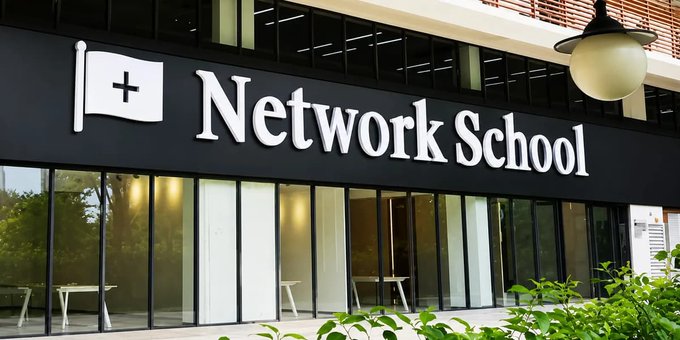
The Network School (NS) has been given a immediate order to cease all operations by today, 22 July 2026. The saga leading up to this uniquely Malaysian debacle has been equal parts technological utopianism, ethnic politics and geopolitical theatre.
The official explanation is one of licensing violations, including operating without a valid business license in certain units and conducting unapproved commercial/classroom activities in spaces designated only for office use. The reality is nothing but politics.
The Network School did not appear overnight. It has been operating openly since 2024 with the full knowledge of the Johor state authorities. Ministers visited. Government agencies promoted it. Malaysia’s investment authorities eagerly showcased it as evidence that the country was serious about attracting AI entrepreneurs, startup founders and global capital to breathe life into the moribund Forest City development.
Forest City has spent years as one of Asia’s most expensive ghost towns. It was a USD 100 billion victim of China’s real estate crisis and is still only partially built. Turning this moribund eyesore into a space for AI founders and digital entrepreneurs fitted neatly into Malaysia’s ambition to capture some of the investment pouring into artificial intelligence while competing with neighbouring Singapore. Tax incentives, special economic zone status and investor-friendly policies were all designed to make Johor an attractive destination.
Enter Balaji Srinivasan.
Srinivasan’s vision of the “Network State” is one of Silicon Valley’s political thought experiments. Rather than treating the nation-state as the natural unit of political organisation, he argues that internet-native communities can first organise online, accumulate capital and members and ultimately acquire physical territory from which they can exercise increasing degrees of autonomy. It is a rather fanciful vision that has now come back to haunt Srinivasan. In the fevered imagination of his critics, the language of acquiring territory quickly became indistinguishable from a familiar accusation of settler colonialism and land grabs.
Srinivasan’s team publicised NS as based on an island off Singapore, never mentioning Malaysia or Johor (this mistake struck deeply at Malaysian insecurities regarding Singapore). Charging almost USD2,000 a month in a location where the going rate was close to a tenth of that reinforced the perception that the project was designed for wealthy foreigners rather than Malaysians. Tech brethren from all over the world (as well as local aspirants) flocked to NS.
Another controversial dimension was the involvement of Nuseir Yassin, better known as Nas Daily, who promoted the initiative (last year) to his enormous online audience. Under ordinary circumstances this would have been little more than influencer marketing. Nas however had an enormous following in this region until his open allegiance to the zionist entity after Oct 7 made him a traitor of the worst sort to malay muslims. Malaysian understanding of the I-P issue is extremely simplistic and binary.

Then politics intervened.
Prime Minister Anwar Ibrahim’s coalition suffered a bruising setback in the recent Johor state election, winning only 8 out of 56 seats. Suddenly, issues that had previously attracted little attention became political bombs.
The government’s own publicity became evidence against it.
Two prominent non-Muslims, Digital Minister Gobind Singh Deo and Deputy Minister Wilson Ugak Kumbong, had publicly visited and promoted the Network School. A pro-palestinian NGO accused the school’s participants of being Israelis, of using dual passports to enter the country illegally. Their only evidence was Nas’ promotion of NS months ago. Raids followed. Malaysia is one of the most anti-semitic countries in the world with anti-Israel sentiment deeply embedded in mainstream political discourse and public life. This transformed the NS into the perfect ideological target.
Balaji Srinivasan’s reaction was the final red flag to an irrational crescendo of hate. He issued an open call to dialogue and threatened to take his project elsewhere. Malaysia is a feudal society where one bows and scrapes to the rulers (ask its chinese entrepreneurs) and the American presumption of equality is alien to malay adat or culture. Even worse it was coming from a Tamil, one of the most lowly minorities in Malaysia.
None of this excuses the Network School’s own mistakes. Balaji Srinivasan’s vision of a “network state” may be intellectually provocative, but its language of building new societies and alternative forms of governance was always likely to invite scrutiny from insecure nations. Srinivasan’s leadership also displayed an almost total lack of understanding of Malaysian politics and culture. His belated attempt to shore up his anti-zionist credentials by emphasising his friendship with Glen Greenwald was quite comical.
The Network School was not undone by regulatory discovery because Malaysia is a rather corrupt country where these are piffling trivialities that can be greased by knowing the right people.
It was undone by domestic politics, international grandstanding on Palestine and public challenge from Srinivas. As an online observer, watching the panic unfold was surreal. I joked to a couple of Malaysian friends that soon schoolgirls in Kelantan would be having mass hysteria outbreaks over ghostly jew sightings. I could yet be right.

