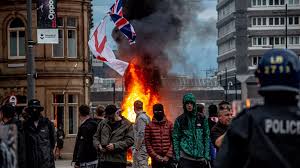
The 2022 unrest in Leicester exposed troubling fault lines not just between British Hindu and Muslim communities but also in how institutions and the media in particular interpreted and reported the events. The Leicester unrest was not a simple case of imported subcontinental political conflict. It was a complex episode driven largely by Islamist disinformation, amplified by social media, and legitimised by media platforms eager to fit events into a familiar narrative of rising Hindu nationalism or Hindutva.
The initial trigger came on August 28 2022, when Indian cricket fans took to the streets in celebration and scuffles broke out but the sustained unrest stemmed largely from organized Islamist agitation, amplified by misinformation.
Claims circulated that Muslims were attacked, a Quran was desecrated, that a young muslim girl was kidnapped and Hindu mobs were being bussed into Leicester.
Central to the misinformation campaign was Majid Freeman, a British Muslim activist with a known history of spreading extremist content. Freeman circulated incendiary narratives online and became the go-to voice for several media outlets, including Channel 4, The Guardian, and even The New York Times. This despite the fact that he had previously posted tributes to jihadists and was later convicted in June 2024 under the Public Order Act for his role in inciting tensions in Leicester. In July 2024, he was further charged with encouraging terrorism in an unrelated matter.
Another key figure was Mohammed Hijab, a social media provocateur known for inflammatory anti-Hindu rhetoric and for calling on Muslims to “defend their community.” He entered Leicester during the height of tensions, further stoking fears and reinforcing the “Hindutva threat” narrative despite the absence of organised Hindu aggression. Hijab has reportedly sued the Spectator and Douglas Murray for defamation over an article discussing his role in the riots.
The events in Leicester came to my notice on Twitter/X and while it was easy to find many British Islamist agitators online, it wasn’t the case for British Hindus. There wasn’t much to report in terms of online British Hindu agitation though there were signs of community co-ordination because a march in Leicester and a small protest in front of the BBC had been organised and media in India was in a frenzy because of obvious information being fed to them. My impression then was of a rather passive and quietist community largely caught unaware by events and having more of a voice in Indian media than in British media.
Post-Leicester there are signs of a resurgent Hindu identity amongst British Hindus who see Leicester as a wake up call and are beginning to organise in response to feeling misrepresented, vulnerable or ignored after the unrest.
Groups like Insight UK, Hindu Forum of Britain, and the National Hindu Students’ Forum have become more vocal and are stepping into a more defiant activist space that traditional temple and social organisations still refuse to inhabit. It’s not just about reaction to Leicester. There is a growing realisation that if British Hindus do not shape their own narrative, others will with little concern for accuracy or fairness.
It behooves us to pay attention to these voices and keep track of where we are heading as a society.

Insight UK invited and hosted a leading voice in Hindu politics in India, J Sai Deepak, on a recent UK speaking tour. Sai Deepak is a very eloquent Supreme court counsel, writer and media personality. Since he speaks and writes in English more often than he does in Hindi, his views can readily perused and analysed. He has been invited to speak at Ivy League universities by Hindu student groups in the US, so Insight UK’s hosting of him is not that strange. Is he controversial? Not particularly in India. But the very fact he is a hindu conservative (he rails a fair bit against western colonialities) does make him immediately suspect in the West. In this speech he alludes to British hindu organisations that had pulled out of his events in the UK (time mark 00:32).
Below is a video of a talk Sai Deepak gave in Cardiff.
Sai Deepak urges British Hindus to “stand up and be counted.” Sai Deepak acknowledges the community’s historical tendency to avoid confrontation and to trust established institutions, but he warns that this approach leaves them vulnerable in today’s complex multicultural landscape.
“It’s time for British Hindus to realize that silent assimilation is no longer enough. We need spaces where our identity is not just tolerated but celebrated, where our contributions are recognized, and where we can defend our interests with confidence.”
Deepak gives historical accounts of riots against Hindus in India and gives a startling “5-year warning” (00:40) of similar fates awaiting British hindus, warning darkly that Leicester was just a testing of the waters. He doesn’t have much faith in western governments which he sees as complicit in a silent invasion of Islamists. He goes on to talk about Pakistan, of course.
My reading of this talk and the audience is that they are being (unnecessarily) tied to much larger forces beyond the UK. Deepak repeatedly refers to his audience as the “Indian diaspora” rather than as a british indian community. The accents of the MC and people in the Q&A don’t sound very british to me and I suspect many in the audience were not born in the UK. I located the blog of a person (born in and educated in India) who attended the talk and he gives quite a critical review.
Did I learn anything new about Hindutva or Sai Deepak ji’s definition of Hindutva? Unfortunately, the answer is negative. Personally, I don’t think there was any new content that I could take home from what I already had.
Possibly the 45 minutes of time allocated was too short, as it was a difficult subject to educate the audience, who would not be aware of Indian history, the Plasseys, Anglo-Maratha Wars, Anglo-Sikh Wars, etc, and then link them to their cultural identity (British Indian!) via the lens of modern India, which they are out of touch with, was a big ask.
At one point, I felt that Sai Deepak ji contradicted himself. He, in the main speech, mentioned the difference between religion and dharma, but then during the question answer sessions, some of his answers had a bit of religious flavour rather than dharmic. Some of the solutions he proposed for retaining identity, or Hindutva, were to ensure that we pray to the 32 (koti) Hindu gods; putting a tilak is a significant symbolic identity that everyone should comply with and should be unashamed of.