Jon MC
Some while ago (2018) there was a controversy and a lot of social media activity around the equivalence (or otherwise) of Church Bells and the Adhan and this article was written in response to that controversy.
More recently, the infamous Mehdi Hasan has stated that: “If you can play your Church bells, we can play the call to prayer. We are as American as anyone else.”
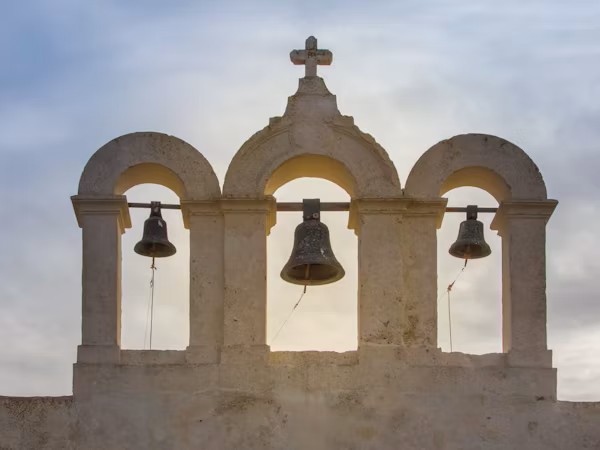
Setting aside such ignorances as the fact that church bells are rung, not played, it seems this might be an appropriate time to look again at this issue since it has come up once more.Church bells are simply a musical reminder (if you like them) or an annoying noise (if you don’t) that tell Christians when their service is about to start.The main difference is that the “Adhan” is words, not music.
And words have meaning.
The very word “Adhan” in Arabic means “information, enlightenment, listening.” Thus the word Adhan itself states that it is more than just a time-signal – unlike church bells (although to be entirely fair some churches ring bells at particular points in a Mass, and this ringing does convey a spiritual message albeit wordlessly and one that only has meaning to the service participants and some churches may still ring “Angelus” bells, but again this is only a time-signal).
Here is what the Sunni version of the adhan actually says in romanised Arabic and English.
Allahu Akbar
The god is greater (said four times) [“Allah” is just a contraction of al-Ilah – “the god”]
Ashhadu an la ilaha illa Allah
I bear witness that there is no god except the god (said two times)
Ashadu anna Muhammadan Rasool Allah
I bear witness that Muhammad is the messenger of the god. (said two times)
Hayya ‘ala-s-Salah
Hurry to/rise up for the prayer
(said two times)
Hayya ‘ala-l-Falah
Hurry to happiness/wellbeing (said two times)
Allahu Akbar
The god is Greater [said two times]
La ilaha illa Allah
There is no god except the god
(Note that Shia have additions and there are also additions for the Sunni call to Fajr prayer. Some other Muslim sects have variations as well.)
Today we all know that Allahu-Akbar “the god is greater!” is often the last thing people hear because it presages an attack by Islamic terrorists (or orthodox Muslims engaging in Holy Sword-Jihad in the way of Allah – if you prefer). As such Allahu-Akbar must be a frightening thing to hear – especially if you are a (persecuted) non-muslim minority in a muslim country. And to hear this repeated over thirty times a day must be a constant reminder of the precarious nature of one’s existence which is, de-facto, at the sufferance of the Muslim population.
Allahu-Akbar is a statement of Islamic supremacy.
The “Omdat Al-Ahkam”, an important book for Islamic law, has this to say about the Adhan:
“Adhan is a very important ritual in the religious practice of Islam, one can liken it to the Muslim flag. Its proclamation shows that the people of the city are Muslims.
It is also important for the proclamation of the word of Allah, thus manifesting the religion of Allah.
The prayer call begins with giving thanks by proclaiming ‘Allahu akbar,’ to show that Allah is the greatest and that everything and everyone should bow to Allah and Islam. The Islamic profession of faith is the second part of the prayer call (‘There is no god but Allah and Muhammad is his messenger.’)
This confirms Islam and proclaims it across the country.
The prayer call should be done by a man who has a beautiful voice. The prayer call should be done with a loud voice. There is promise of a reward from Allah for a loud voice that reaches as far as possible. The prayer call will take place at the exact time of the five prayers.”
In “A summary of Islamic Jurisprudence” by Fawzan, we read:
Each of the prayer call (Adhan) and the immediate prayer call (iqamah) has special wording which express creed and faith. Both of them begin with takbir (saying “Allahu-Akbar” i.e. “Allah is the greatest”) which is a sign of glorification of Allah, Almighty and Ever-Majestic be He. Then the Two Testifications of of Faith are to be declared [“I testify that there is no Deity but Allah” & “I testify that Mohammed is the Messenger of Allah”.] as an acknowledgement of the Oneness of Allah, Exalted and Glorified be He, and the prophethood of our Prophet, Muhammed (PBUH). After that, a call for prayer, the basic pillar of Islam, is pronounced, following which a call for prosperity is pronounced, inviting all Muslims for prayer, the way to felicity and eternal delights [Houris etc.]. Finally, the wording of the prayer call ends with the takbir, which is the best way of remembrance of Allah and the word of sincerity and faith, whose greatness and virtue outweigh the seven heavens with all beings therein (excluding Allah) and the seven earths with all the beings therein.”
Moulana Ihtishamul Hasan Sahib Kandhelwi writes:
“The adhan is generally regarded as merely a call to salah but in reality, the secret of the loftiness and elevation of the Muslims is concealed in it. The adhan is not merely an announcement for salah but is in fact an open invitation to Islam five times daily in every place.”
In another article he says:
“Now the adhan is an announcement of true Deen [Islamic faith] and an elevation of the true word. … The place where the adhan is delivered [heard] is regarded as Darul Islam – an Islamic governed state. Whenever Nabi [Mohammed] heard the adhan from any locality, he did not attack that locality. If he did not hear the adhan, he would attack that place. … A person should stand on a high place and recite these words with a loud voice. Whatever distance his voice reaches, that is where the announcement of truth [Islam] will reach. … The city, town or village where the adhan is delivered is saved from the general punishment and wrath of Allah on that day [the day of judgement]. Imam Tabarani has narrated from Anas that Nabi said, ‘When the adhan is called out in any village, Allah saves that village from His punishment on that day.‛ [Jam’ul Fawaid] … the actual aim of adhan is very high and noble, being the root of the religion of Islam. It is the real aim of the mission of all the prophets and messengers. The adhan is an open announcement and exposition of the Deen of Allah Ta’ala.
Shah Waliullah (Rahimahullah) writes:
“[Adhan] has become to the uninformed and the informed a call to Deen [Islamic faith]. Accepting it became a sign of submitting to Allah. Therefore it was necessary for the adhan to contain the mention of Allah, a testimony to the oneness of Allah and the prophethood of Nabi …”
Note what has been said above: the Adhan proclaims, confirms and manifests Islam across the country, it expresses creed and faith. It also states that Allah and the Muslims are supreme.
In other words the Adhan is a credal statement that proclaims Islamic and hence Muslim supremacy as well as Muslim ownership of the land in which it is heard. (No wonder some Muslims in those western enclaves where the Adhan is heard – or not – consider Islamic law above the law of the land and no wonder they are no-go areas for the arms of the kaffir government.)
It is worth remembering that in muslim countries, churches and temples have to ring bells, sound horns etc. in a quiet manner so as to not disturb the tranquillity of the muslims and church and temple buildings have to be lower in height than the mosques to show the ‘inferiority’ of these kaffir religions. For similar reasons in many muslim countries non-muslims have the greatest difficulty in getting permission to build or even repair their religious buildings, this with the aim of literally silencing non-islamic religions and making them disappear from the public sphere.
Back to the titular question: church bells and the muslim call to prayer are the same thing, aren’t they?
Clearly the answer is “No, they are not!”
The ringing of church bells is either a simple time-signal or else has meaning within the service, but this meaning would only be known to those familiar with such services. In any case they make no credal claims.
In contrast the adhan is the spoken word and words inherently have meaning. The adhan is a statement of and call to the islamic “Deen”, a statement of islamic and muslim supremacy and a declaration that the land in which the adhan is heard is Darul Islam, land that is owned by Islam and Muslims and that in perpetuity¹.
Do all muslims believe those statements about the adhan? No, I’m sure they do not. But orthodox muslims will believe that or something similar.
A final thought.
In much of the West if people find the weekly church bells a disturbance, they can apply to have the bells silenced under “noise abatement” legislation (to use the UK example). Some such applications have been successful.
I wonder how that would go if you tried to silence the Muslim adhan blared via loudspeakers from the mosque?
Notes:
1. The idea that an area of land once claimed by Islam is forever Islamic can be evidenced from the claims amongst orthodox Muslims upon the Land of Israel, “Al-Andalus” (Portugal and much of Spain), the former Ottoman lands in Europe, Kashmir, etc.